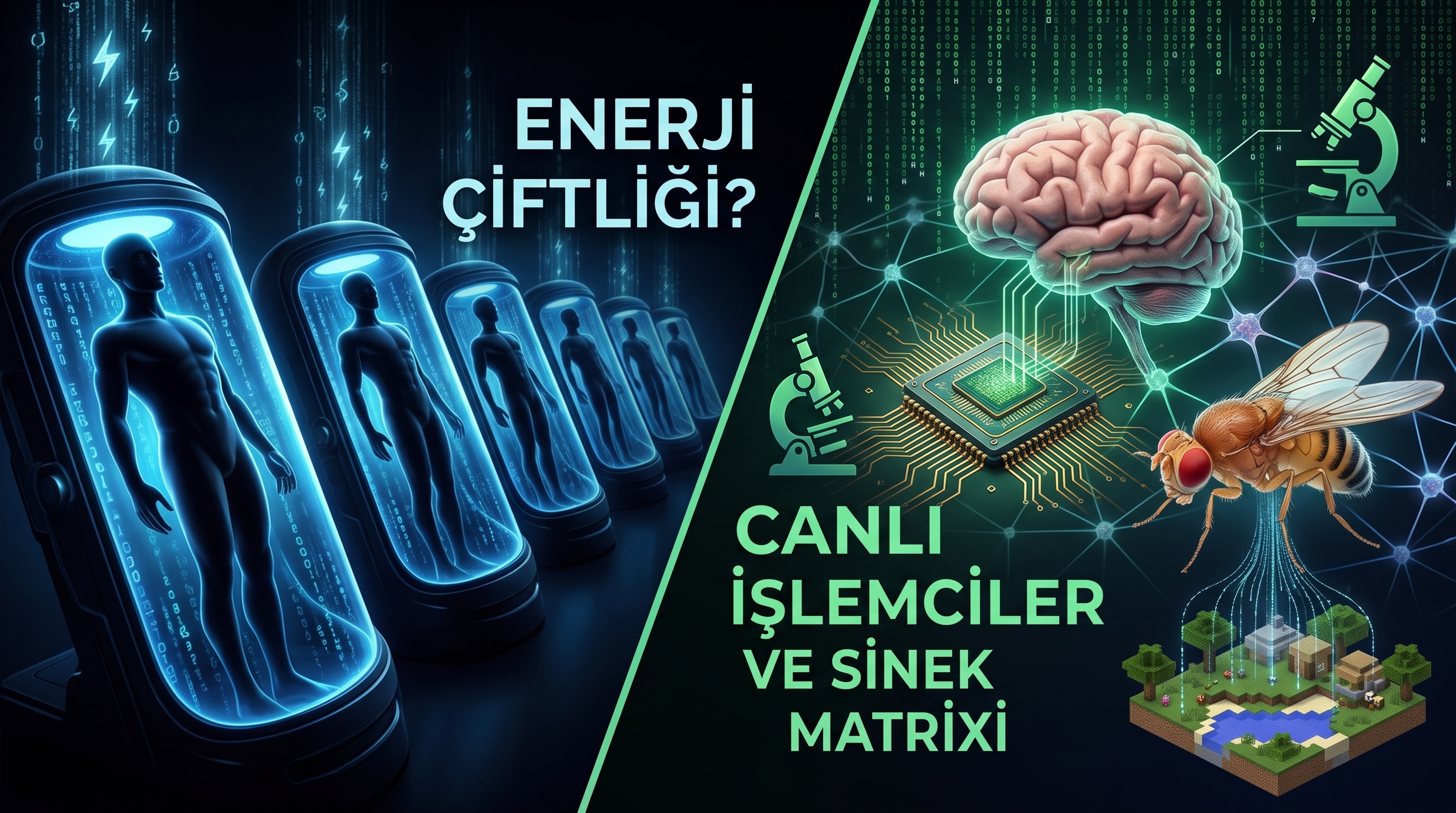
You know the scene in 1999's The Matrix where Morpheus tells the truth to Neo. The sky darkens, the machines are deprived of the sun, and they find the solution by turning human bodies into batteries.
Although it looks impressive in the cinema, it is a fiasco when viewed from the perspective of biology and physics. Even if you lie doing nothing all day, your body consumes approximately 100 watts of metabolic power. Most of this energy is dissipated into the environment as heat. If the human body is on average 37 degrees and the room temperature is 20 degrees, the theoretical efficiency limit of even a perfect thermodynamic system that will collect this heat and convert it into electricity remains around 5-6 percent.
In other words, you first spend energy to feed people, and then you can only get back a small portion of the heat released. Moreover, doing this while machines have fusion technology is no different than building the most expensive and meaningless farm in the world.
But there's a claim about the original draft of the screenplay floating around: The Wachowski brothers didn't initially think of humans as batteries. The story had a much more logical purpose, but was changed because it was too dark for the studio. What the machines were after was not heat, but the human brain itself.
Hardware Working with 20 Watt
The human brain weighs approximately 1.4 kilograms and consumes only 20 watts of power. There are 86 billion neurons in it. Although computers perform mathematical operations many times faster than us, the brain has a completely different advantage: It can change its physical connections as it gains experience and instantly make sense of incomplete data.
What the machines were looking for was not raw processing speed, but a biological processor that could reshape its own hardware according to the situation.
This idea is no longer limited to science fiction. Similar steps are being taken in laboratories:
- In 2022, Cortical Labs researchers taught how to play Pong by giving electrical feedback to 800 thousand live neurons on a silicon chip.
- In 2023, 3D brain organoids (Brainoware) produced from stem cells were used directly as processor parts in tasks such as speech recognition.
- Today, the same team has opened servers containing live neurons to remote access over the internet with the system they call CL1.
However, if you want to use a living brain tissue as a processor, you have to present it with a problem to solve, that is, an environment in which it can receive data and react. In other words, you have to give it a simulation, the Matrix.
Things Got Serious: They Copied the Brain of a Fly and Put It in a Simulation
The most concrete and somewhat frightening evidence of this theory came recently. Scientists mapped the brain of a fruit fly (Drosophila melanogaster) neuron by neuron and transferred it to a virtual environment.
In the FlyWire project carried out by institutions such as Princeton, Harvard and Google Research, the brain of an adult fly was sliced with electron microscopes. The result was a complete wiring diagram (connectome) containing more than 130 thousand neurons and more than 50 million synapses.
The researchers didn't just leave this diagram as a map; They connected the digital neural network to physics simulations.
This is where the crucial part begins: No machine learning model has taught the virtual fly to walk, flap its wings, or clean itself with its legs. Virtual data from the environment triggered digital neurons, the neurons transmitted the signal, and the virtual muscles in the model contracted. The fly staggered, moved and wandered around in the simulation just like in real life.
In other words, they transferred the brain of a living creature to the digital environment and built a special Matrix for it.
The Body Was Already Excessive
In the movie, machines kept people with their arms and legs in giant capsules. However, Yale University's BrainEx study in 2019 showed that a brain can circulate outside the body even hours after death. If the goal was pure processing power, machines didn't need our arms or legs; Only living brains with which they could exchange data were sufficient.
As we see in the fruit fly example, it does not matter what is outside for the mind inside, as long as the signals entering the nervous system are transferred correctly. Everything our eyes see and our skin feels are just electric pulses that eventually reach our brain.
Maybe the machines in the Matrix were not after energy as the movie portrays. They made the human brain the biological core of their supercomputer. Every study we see today, from cells grown on chips to digital flies walking in simulation, shows that that fiction is based on a much more familiar logic than we think.
Resources
- Bebar Science: The Biggest Mistake of the Matrix and the Real Studies That Lead to the Matrix
- Kagan, B. J. et al. (2022). In vitro neurons learn and exhibit sentience when embodied in a simulated game-world (DishBrain, Cell)
- Cai, H. et al. (2023). Brainoware: Directed differentiation of human pluripotent stem cells into functional 3D brain organoids for biocomputing (Nature Electronics)
- Dorkenwald, S. et al. / FlyWire Consortium (2024). Neuronal wiring diagram of an adult Drosophila brain (Nature)
- Vrselja, Z. et al. (2019). Restoration of brain circulation and cellular functions hours post-mortem (BrainEx, Nature)